Many middle schools use standards, percentages, or letter grades without publishing a GPA. An online result is useful for practice only if the school has not defined an official calculation.
Equal-class method
If every course is treated equally, map each final letter grade to the school's points table, add the points, and divide by the number of classes.
Worked example
| Class | Final grade | Example points |
|---|---|---|
| English | A | 4.0 |
| Math | B | 3.0 |
| Science | A- | 3.7 |
| Social studies | B+ | 3.3 |
When do credits matter in middle-school GPA?
Some eighth-grade courses can earn high school credit. That does not automatically mean the middle school report card uses high school GPA rules. Ask whether the course enters the future high school transcript, what credit it carries, and whether it receives any weighting.
Which GPA mistakes should families avoid?
- Converting percentages with an unofficial universal table.
- Adding an Honors bonus that the school does not award.
- Averaging quarter grades after a final course grade already summarizes them.
- Assuming a practice GPA will appear on the transcript.
Use the estimate for a learning conversation
A middle-school estimate is most useful when it points to a specific class, missing skill, or study habit. It should not be treated as a college-admission forecast. Compare course-level patterns, ask teachers how standards are measured, and focus on the next unit or grading period.
When a family tracks results over time, keep the same scale and course set. Changing the conversion table between quarters can create an apparent GPA change that did not come from new grades.
Use the report card language
If the school reports proficiency levels instead of A to F grades, do not invent a GPA conversion. Review progress using the published standards.
Use one documented scale across grading periods
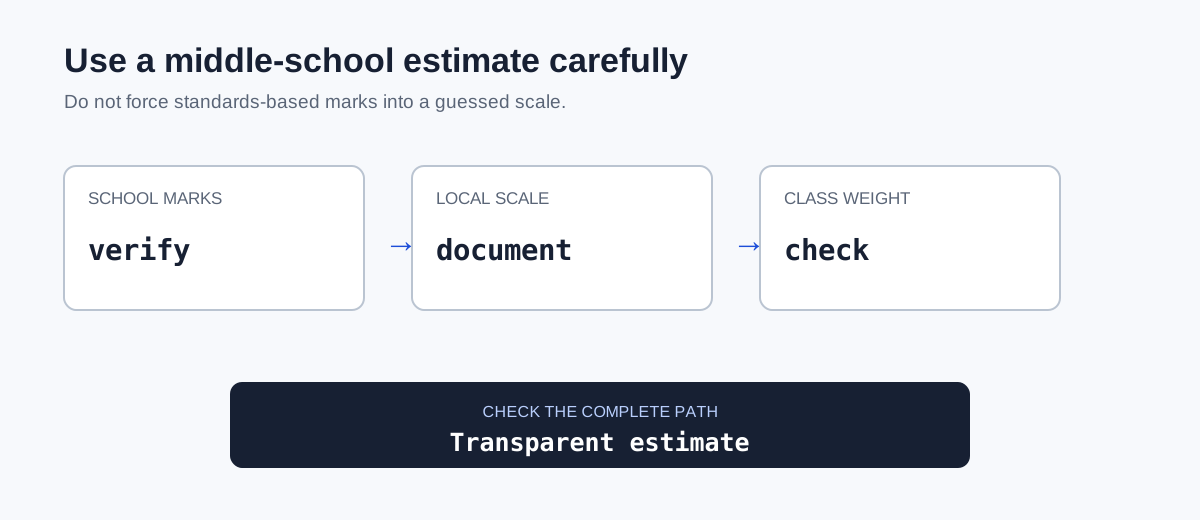
If a school reports standards, proficiency levels, or narrative marks, do not force those symbols into a 4.0 table unless the school publishes a conversion. When letter grades are available, copy the exact plus/minus treatment and decide whether all classes carry equal weight before calculating.
For a quarter-to-quarter comparison, keep the course set and scale constant. Show the result beside the underlying grades so a family can see whether the change came from one subject, a different denominator, or a real shift across several classes. The purpose is to support a conversation about learning and next steps, not to manufacture an admissions-style record years before high school.
Check whether the grade becomes high-school credit
Some middle-school courses can appear on a later transcript. Ask the school how those credits and grades are treated before combining them with high-school work.
A four-pass check for this method
A reliable middle school gpa estimate should leave an audit trail, not just a final number. Work through these four passes in order and keep the source for every scale, weight, credit value, and inclusion decision beside the calculation.
- Check whether the school uses letter grades, standards, or another scale.
- Convert marks only when the school publishes a defensible mapping.
- Decide whether classes have equal weight or carry credits.
- Keep the estimate beside the underlying grades and school policy.
After the four passes, change one input at a time and calculate again. The direction and size of the change should match the rule you documented. Preserve unrounded values until the final display, label hypothetical inputs, and keep institutional results separate from estimates created for planning. If the worksheet still disagrees with an official record, compare the included courses and denominator before assuming the arithmetic is wrong.
Keep the original marks next to every converted value. If the school reports standards rather than letter grades, the original record should remain primary and the estimate should be clearly labeled. Save the source date with the worksheet so a later policy change does not silently alter the meaning of the estimate.
Sources
When every included class counts equally, enter the letter grades in the GPA calculator without credits. If classes carry different credit values, use a credit-weighted method instead.