In a category-weighted class, a category with 40 percent of the course affects the result twice as much as one worth 20 percent. Do not average the category percentages directly.
The formula
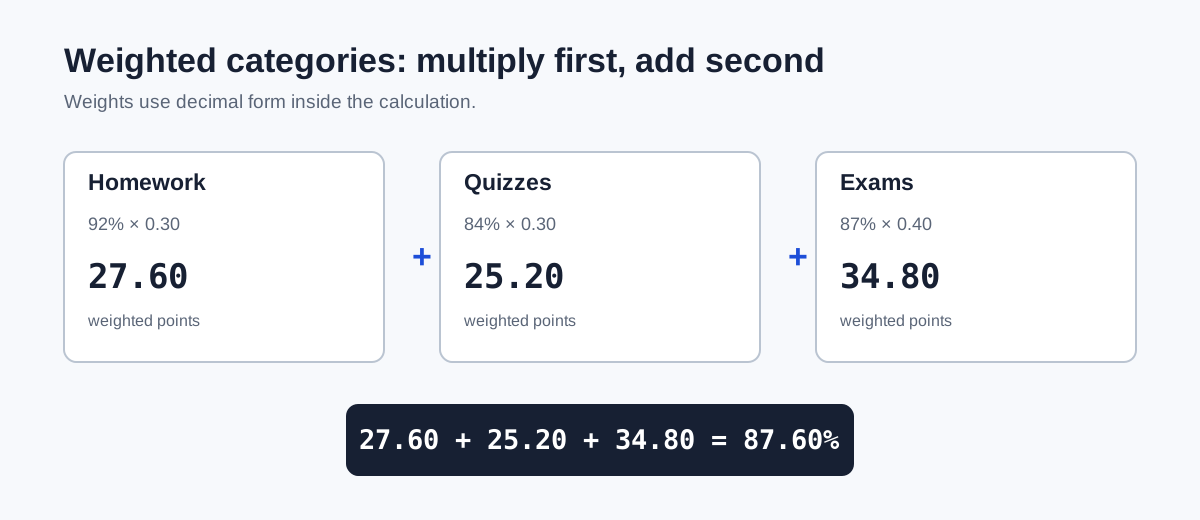
Worked example
| Category | Average | Weight | Contribution |
|---|---|---|---|
| Assignments | 88 | 40% | 35.20 |
| Quizzes | 92 | 25% | 23.00 |
| Exams | 81 | 35% | 28.35 |
| Total | 100% | 86.55 |
How should incomplete categories be handled?
A gradebook can omit an empty category and temporarily rescale the others, or it can count that category as zero. To estimate the grade earned so far, divide completed category contributions by their completed weight. To forecast the final grade, include realistic scores for remaining categories.
Example with an incomplete category
Suppose assignments average 88 and are worth 40 percent, while quizzes average 92 and are worth 25 percent. The 35 percent exam category has no grades yet. The completed contributions total 58.20 points across 65 percent of the course.
To forecast the course, add an exam scenario instead of renormalizing. An exam average of 81 contributes 28.35 points and produces the 86.55 final estimate shown above. Label the two figures clearly so a temporary grade is not mistaken for a completed result.
Build a category worksheet that can be checked
- Record each category name exactly as it appears in the syllabus.
- Calculate the raw average inside each category before applying its course weight.
- Mark categories as completed, in progress, or not started.
- Confirm that the published weights total 100 percent.
- Add the weighted contributions and preserve at least two decimal places.
The grade calculator with weights follows this worksheet structure and warns when category weights do not total 100 percent.
How is a weighted grade different from weighted GPA?
A weighted course grade combines assignments inside one course. A weighted GPA adds rigor weight to course grades across a transcript. The two calculations solve different questions.
Verify category averages before weighting
The category average must be correct before it is multiplied by the course weight. In a points-based category, add earned points and divide by possible points. In an equal-item category, confirm that every assignment truly counts equally. A ten-point quiz and a one-hundred-point project should not receive equal influence unless the instructor explicitly uses equal-item averaging.
As a quick audit, add all weighted contributions. A completed course should produce a total between 0 and 100 under an ordinary percentage system.
Check for rules inside categories
Dropped assignments, late penalties, point caps, and exam replacement policies can change a category average before its course weight is applied.
Forecast remaining categories without double counting
Start with the contribution already earned in completed categories. Add one scenario for each unfinished category, multiplied by its original syllabus weight. Do not use a gradebook’s temporarily normalized “grade so far” as though it were a completed category contribution; that number has already rescaled the finished work.
| Scenario | Remaining 35% average | Added contribution | Final estimate from 58.20 earned points |
|---|---|---|---|
| Conservative | 75% | 26.25 | 84.45% |
| Expected | 85% | 29.75 | 87.95% |
| Strong | 95% | 33.25 | 91.45% |
The three outcomes show the real range created by the remaining weight. They also make a target testable: a 90 final grade would require 31.80 more contribution points, or 31.80 ÷ 0.35 = 90.86 percent across the unfinished category.
Treat extra credit according to the gradebook model
Extra credit may raise a category score, add points to the course numerator, or create a separate weighted category. Apply it exactly once in the place the syllabus specifies. Adding the same bonus to a category average and again to the final course grade overstates its effect.