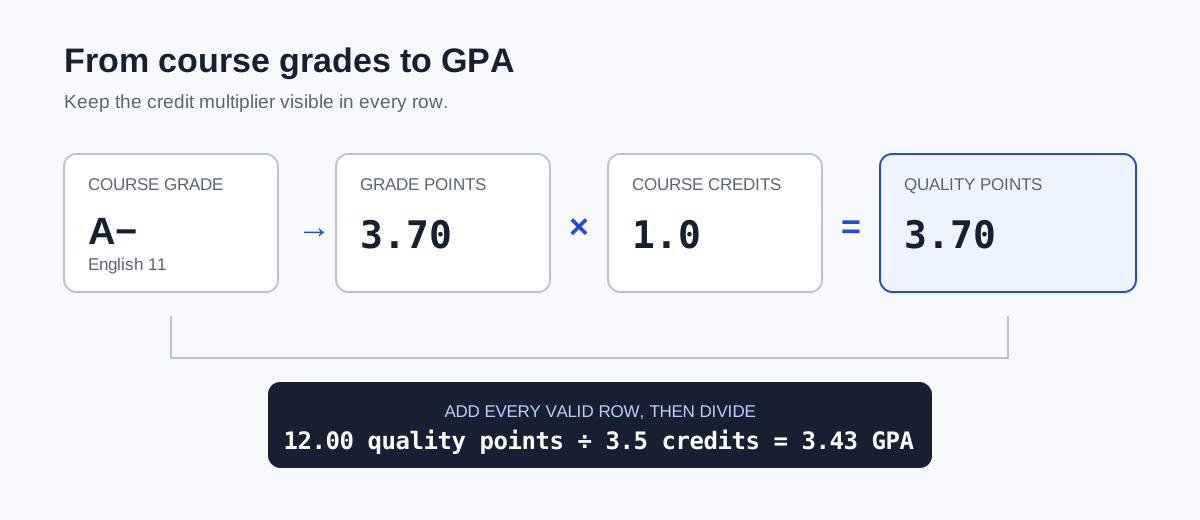
A grade point average is not usually an average of the percentages printed in a gradebook. The common method first converts each final course grade into grade points. If courses carry different credits, those points are then weighted by the credits.
The GPA formula
This credit-weighted method is used by many US colleges. For example, the University of Illinois registrar instructs students to multiply each course's grade points by its credit hours, add the quality points, and divide by GPA hours.
Calculate your GPA in four parts
Find the grade scale your school uses
Start with the scale published in your handbook or transcript key. A traditional unweighted scale commonly assigns A = 4.0, B = 3.0, C = 2.0, D = 1.0, and F = 0. Plus and minus grades vary. Some schools use 3.7 for A-, while others use 3.67.
Convert each final grade to grade points
Use final course grades unless the school says grading periods count separately. Do not convert an AP Exam score of 1 to 5 into course GPA points. The AP Exam score and the grade earned in the AP course are different records.
Multiply each course by its credits
A one-credit A contributes 4.0 quality points. A half-credit A contributes 2.0 quality points. This is why simply averaging a list of grade points can be wrong when course credits differ.
Add and divide
Add all quality points, add all credits that count toward GPA, then divide. Keep the unrounded result until the end so repeated rounding does not change the answer.
Worked example with mixed credits
Four-course term
This example uses A- = 3.7 and B+ = 3.3. Health is a half-credit course.
| Course | Grade | Grade points | Credits | Quality points |
|---|---|---|---|---|
| English 11 | A- | 3.70 | 1.0 | 3.70 |
| Biology | B+ | 3.30 | 1.0 | 3.30 |
| Health | A | 4.00 | 0.5 | 2.00 |
| Algebra II | B | 3.00 | 1.0 | 3.00 |
| Total | 3.5 | 12.00 |
Why might your official GPA differ?
The arithmetic can be correct while the result still differs from a transcript. Schools make different policy choices about which courses count, how plus and minus grades map to points, and whether a repeated course replaces an earlier grade.
- Weighting: Honors, AP, IB, or dual-enrollment courses may receive a bonus.
- Repeated courses: Some institutions replace the first grade, while others include both attempts.
- Pass/fail courses: Credits may count toward graduation without entering the GPA.
- Transfer courses: Accepted credits may or may not affect the institution's GPA.
- Rounding: A school may round, truncate, or display more decimal places.
Use the official rule first
The University of Illinois, for example, displays two decimal places and truncates rather than rounds its official transcript GPA. GradeHorizon currently rounds examples to two decimals, so an Illinois transcript can differ by 0.01.
What if every class has equal credit?
If every course has the same credit value, add the grade points and divide by the number of courses. This shortcut works because equal credits cancel out. Do not use it when one course is worth half a credit and another is worth a full credit.
Audit the calculation before trusting it
A reliable GPA worksheet should be reversible. After calculating the GPA, multiply the result by the total credits. The product should return to the total quality points, allowing only for the final rounding step. In the example above, 3.428571... multiplied by 3.5 credits returns 12.00 quality points. If it does not, a grade value, credit amount, or row was entered incorrectly.
Run a denominator check
The most common spreadsheet error is a mismatched denominator. Credits excluded from the quality-point total must also be excluded from GPA credits. A pass/fail course, withdrawal, or transfer course cannot stay in only one side of the formula. Make a separate “included in GPA?” column and apply the same decision to both totals.
Keep policy decisions separate from arithmetic
First reproduce the transcript using the school’s published scale. Then create any planning scenario in a separate copy. This prevents an assumed AP bonus, repeated-course rule, or plus/minus value from silently changing what is supposed to be a record check.
| Audit question | What to compare | Likely problem if it fails |
|---|---|---|
| Do credits add up? | Course rows vs. transcript GPA credits | Excluded or duplicated course |
| Do quality points reverse? | Displayed GPA × displayed credits | Rounding too early or wrong grade points |
| Does weighting match? | Advanced-course labels vs. school profile | Unsupported bonus assumption |
| Does the period match? | Semester, year, or cumulative record | Mixing different time spans |
Save the scale, included courses, and unrounded totals beside the result. Those notes make the estimate reproducible later when a grade changes or an official record becomes available.
Sources
- College Board BigFuture: How to Calculate Your GPA on a 4.0 Scale
- University of Illinois Registrar: Calculate Your GPA
- UCLA Registrar: Grades and GPA calculation
To check the arithmetic with your own courses, use the high school GPA calculator; it exposes the quality-point total and credit denominator used in the result.