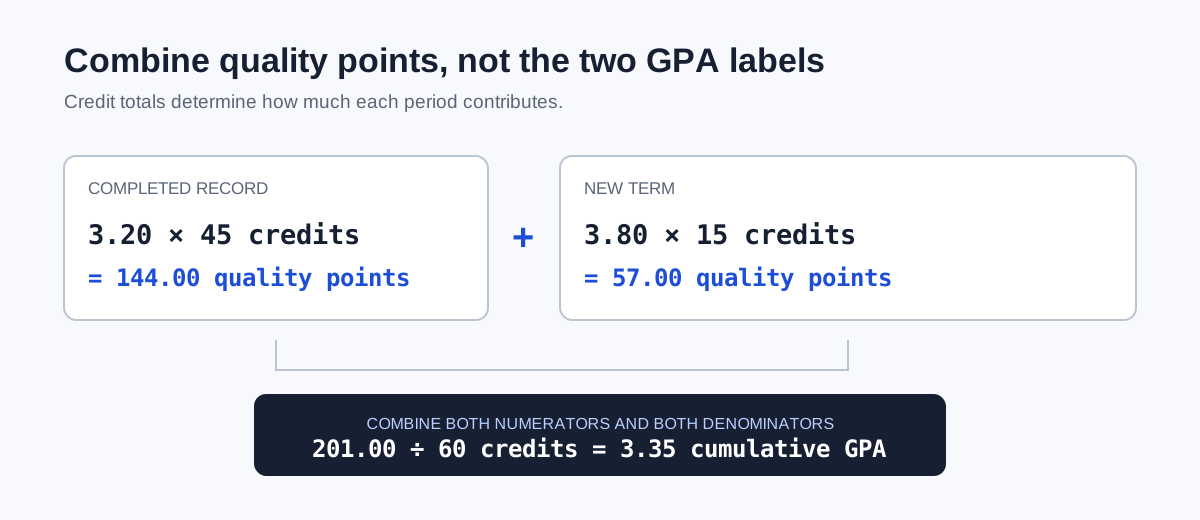
A strong semester can raise a cumulative GPA, but it does not replace the earlier record. Every included grade still contributes quality points. The number of credits behind each GPA determines how much influence it has.
The difference in plain language
Semester GPA, sometimes called term GPA, uses only the courses included in one academic term. Cumulative GPA uses all GPA courses included by the school through the end of the latest term.
Penn State describes semester GPA as the average for one semester and cumulative GPA as the average for all courses completed at the university. The University of Illinois also distinguishes term, overall, institutional, and transfer GPA. Your transcript key determines the exact scope at your school.
The correct formula
Use the unrounded GPA from the school record if it is available. Multiplying a displayed GPA that has already been rounded can introduce a small difference.
Worked example
One new semester added to an existing record
A student has a 3.27 cumulative GPA across 42 credits. The next semester produces a 3.71 GPA across 15 credits.
| Record | GPA | Credits | Quality points |
|---|---|---|---|
| Earlier terms | 3.27 | 42 | 137.34 |
| New semester | 3.71 | 15 | 55.65 |
| Combined | 57 | 192.99 |
Why can averaging two GPAs be wrong?
Averaging 3.27 and 3.71 gives 3.49, which is not the cumulative result above. That shortcut treats 42 earlier credits and 15 new credits as if they carried equal weight.
You may average two term GPAs only when both terms contain the same number of GPA credits and the GPAs use the same scale and course rules. The quality-points method is safer because it works for equal and unequal terms.
What should you check on the transcript?
- Institutional courses: Some schools calculate a separate GPA using only courses taken there.
- Transfer work: Transfer credits can count toward a degree without entering the institutional GPA.
- Repeated courses: A repeat may replace, exclude, or sit beside the first grade.
- Pass/fail work: A passing course can award credits without adding quality points.
- In-progress courses: Courses without final grades generally do not enter the official GPA yet.
Do not reconstruct an official GPA from course credits alone
Look for GPA hours or GPA credits on the transcript. Attempted, earned, and GPA credits can be different totals.
Use term GPA for planning
To test a future semester, calculate the proposed courses as one term, convert that term to quality points, and combine it with the current record. This shows the estimated direction of change without implying that a forecast is an official result.
Plan a cumulative target with quality points
A target cumulative GPA can be converted into a quality-point requirement. Multiply the target GPA by the credits you expect to have after the new term. Subtract the quality points already earned. The remainder is the number of quality points the new courses must contribute.
Suppose a student has a 3.20 GPA across 30 credits and plans 15 more credits. Finishing with a 3.30 cumulative GPA would require 3.30 × 45 = 148.50 total quality points. The current record contains 3.20 × 30 = 96.00 points, so the new term must contribute 52.50 points. Dividing by 15 gives a required term GPA of 3.50.
Check whether the target is possible
Compare the required term GPA with the highest value allowed by the applicable scale. If an unweighted plan requires more than 4.0, the target is not reachable in that number of credits. The useful next question is how many additional credits at a realistic term GPA would be needed—not how to force the original equation to fit.
Use scenarios instead of one forecast
Build conservative, expected, and strong term scenarios. Each should use the same completed record and planned credit total. This shows how sensitive the cumulative result is to the upcoming term and makes clear why an early 15-credit semester usually moves a GPA more than a later one added to a 100-credit record.
A four-pass check for this method
A reliable semester vs cumulative gpa estimate should leave an audit trail, not just a final number. Work through these four passes in order and keep the source for every scale, weight, credit value, and inclusion decision beside the calculation.
- Convert the previous cumulative GPA back to quality points.
- Calculate the new semester’s quality points and GPA hours.
- Add the two quality-point totals and the two hour totals.
- Divide once to obtain the updated cumulative estimate.
After the four passes, change one input at a time and calculate again. The direction and size of the change should match the rule you documented. Preserve unrounded values until the final display, label hypothetical inputs, and keep institutional results separate from estimates created for planning. If the worksheet still disagrees with an official record, compare the included courses and denominator before assuming the arithmetic is wrong.
Check that the updated result lies between the old cumulative and new semester GPAs and sits closer to the record with more GPA hours. Save the source date with the worksheet so a later policy change does not silently alter the meaning of the estimate.
Sources
- Penn State Registrar: Grade-Point Average
- University of Illinois Registrar: Calculate Your GPA
- The University of Texas at Austin Registrar: GPA Calculator
Use the cumulative GPA calculator to combine the old record and a new semester through quality points and credits rather than directly averaging the two GPAs.