Raising a cumulative GPA becomes slower as completed credits accumulate. One excellent semester has a large effect early in a record and a smaller effect after several years. The useful question is not simply, "Can I raise it?" It is, "What average do I need across the credits I still have?"
Collect three numbers
- Current cumulative GPA: Use the official value from the latest transcript or grade report.
- Current GPA credits: Use GPA hours, not earned credits, if the transcript distinguishes them.
- Future GPA credits: Count only courses expected to enter the same GPA.
Then choose a target. A target is a planning point, not a promise about admission, honors, scholarships, or eligibility.
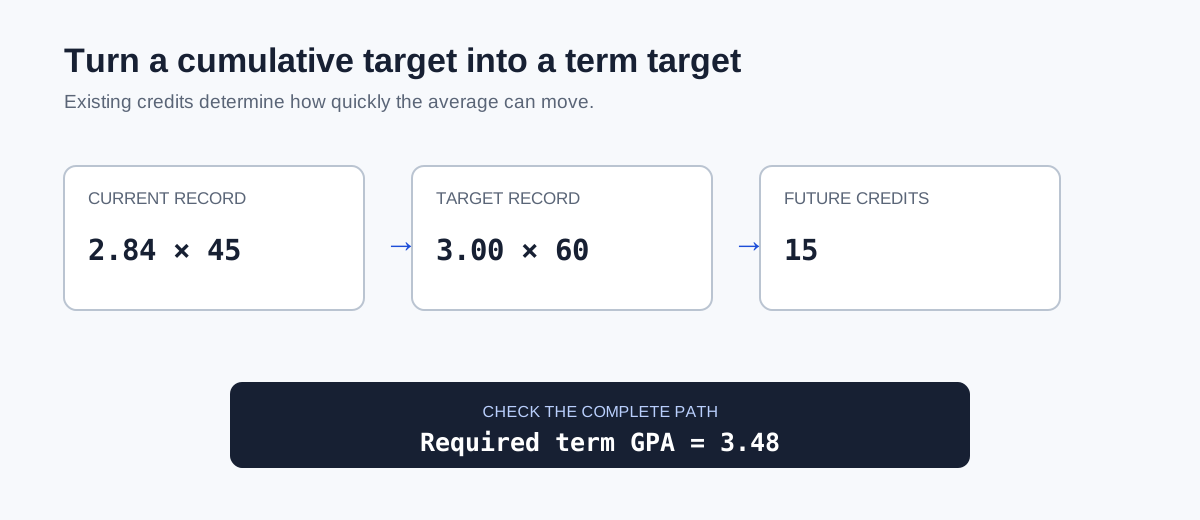
Find the future GPA required
Worked example: moving from 2.84 to 3.00
A target across the next 18 credits
A student has a 2.84 cumulative GPA across 38 GPA credits and wants an estimated 3.00 after 18 more credits.
| Step | Calculation | Result |
|---|---|---|
| Current quality points | 2.84 × 38 | 107.92 |
| Target total quality points | 3.00 × 56 | 168.00 |
| Points needed in future work | 168.00 - 107.92 | 60.08 |
| Required future GPA | 60.08 ÷ 18 | 3.3377... |
Check whether the target is mathematically possible
Compare the required future GPA with the highest GPA available on the same scale. If an unweighted target requires a 4.24 future GPA on a 4.0 scale, it cannot be reached in the number of credits entered. Change the target, extend the timeline, or verify whether the school uses a weighted scale.
A calculator should show an impossible result instead of silently capping it at 4.0. The impossible number explains how far the current plan is from the target.
Turn the number into a course plan
- Map grade combinations: Test realistic grades for each course and weight them by credits.
- Protect high-credit courses: A grade in a full-credit course affects GPA more than the same grade in a half-credit course.
- Use support early: Office hours, tutoring, study groups, and instructor feedback are more useful before a final grade is locked.
- Track course requirements: Dropping or changing a course can affect graduation, aid, athletics, or full-time status. Ask the appropriate school office first.
- Choose rigor for the right reasons: Do not take an advanced course only because a local weighting bonus looks attractive. Workload, preparation, and academic goals matter too.
Do repeated courses erase the old grade?
There is no universal rule. UCLA, for example, limits when a course may be repeated and explains how grades from authorized repetitions enter the GPA. Another institution may keep both attempts or apply a different replacement policy. Check the rule before building a recovery plan around a repeated course.
Ask a specific policy question
Instead of asking whether repeats "count," ask which attempt appears on the transcript, which attempt contributes quality points, whether credits are counted once or twice, and whether limits apply.
What can this calculation not predict?
It cannot predict final course grades, changes in school policy, course availability, or how an outside organization recalculates GPA. Colleges and scholarship programs may use selected subjects or their own scale. Use the result to plan conversations with a counselor or adviser, not as an official forecast.
Recalculate the target at three checkpoints
A cumulative target should be updated after grades post, after the next schedule is fixed, and before a withdrawal or repeat deadline. At each checkpoint, replace planned credits and grades with the newest official information. This prevents an old projection from continuing to guide decisions after the denominator has changed.
Keep a base case, a realistic improvement case, and a maximum-grade case. The base case shows what happens if performance remains similar; the improvement case translates a goal into course-level work; the maximum case tests mathematical feasibility. If even the maximum case misses the target, extend the time horizon or choose a nearer milestone instead of treating an impossible term GPA as a study plan.
Sources
- The University of Texas at Austin Registrar: GPA Calculator
- University of Illinois Registrar: Calculate Your GPA
- UCLA Registrar: Repetition of Courses
Use the cumulative GPA calculator to combine completed credits with a realistic future term. It preserves the influence of the credits already earned instead of averaging two GPA values.