A pass/fail course can affect academic progress without changing institutional GPA. The key is to separate earned credits, GPA credits, and quality points.
How is a passing mark usually treated?
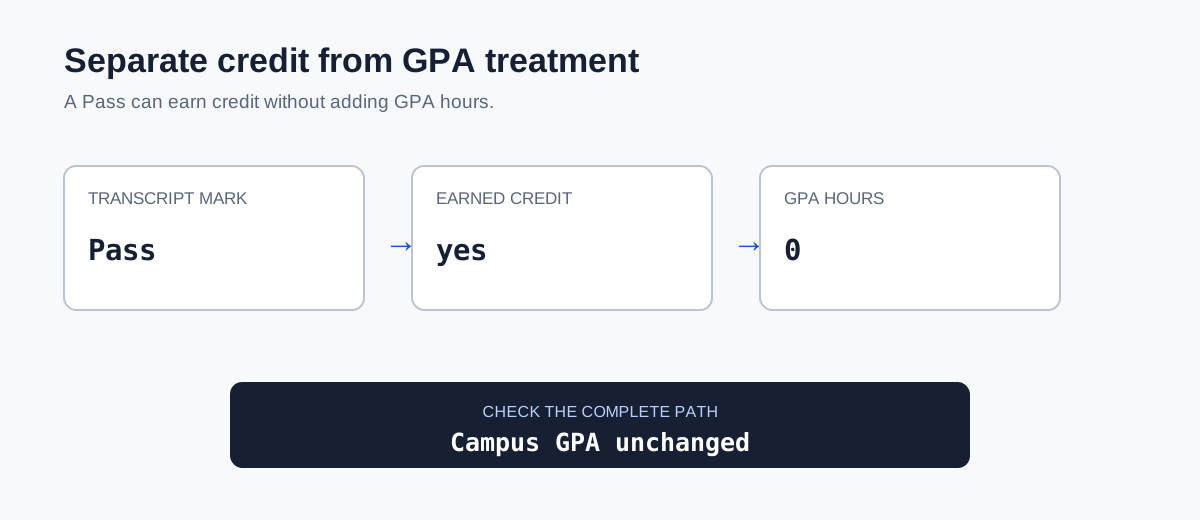
Many universities exclude passing P or S grades from GPA while allowing the credits to count toward degree progress. UC Berkeley, for example, states that P and S grades carry no grade points and their units are excluded from GPA determination.
How can a failing pass/fail mark differ?
An F, NP, U, or similar symbol can be treated as zero grade points at some institutions or services. Do not assume the passing and failing sides of a pass/fail option are symmetrical.
Transcript-total example
A student has 36 graded GPA credits and 126 quality points, plus a three-credit course marked Pass that is excluded from GPA:
Application-service treatment
AAMC reports many pass/fail course types as supplemental hours rather than including them in AMCAS GPA, but applicants must follow the current course-entry and verification instructions. LSAC also publishes separate rules for passing and failing symbols. The institutional transcript alone does not predict every application GPA.
Before choosing pass/fail
- Check major and prerequisite grade requirements.
- Check scholarship, honors, athletics, and satisfactory-progress rules.
- Ask whether the choice can be reversed after a deadline.
- Review graduate or professional application instructions.
Compare the transcript scenarios
Before selecting pass/fail, write down how the course would appear under each allowed option: letter grade, Pass, or a failing symbol. Record earned credits, GPA credits, quality points, and whether the course still satisfies the intended requirement. This separates a GPA effect from a degree-progress effect.
For professional-school planning, maintain a second scenario using the current application-service rules. An institutional choice that excludes a course from campus GPA may still need to be reported and classified elsewhere.
No universal GPA boost
Changing a low expected letter grade to Pass may leave GPA unchanged, but it can affect prerequisites or how another organization reviews the course.
Separate the GPA effect from earned credit
For each allowed grading option, record four outputs: the transcript symbol, earned credits, GPA credits, and quality points. A passing mark can preserve degree credit while contributing zero GPA credits and zero quality points. A failing pass/fail mark may be treated differently, so it must be checked against the institution's published rule.
Then review consequences outside the campus GPA. A major, scholarship, athletic program, graduate application, or professional-school service may require the course to be reported or may apply its own treatment. Choosing pass/fail can therefore leave the institutional average unchanged while affecting a prerequisite or an outside calculation.
Model both transcript paths
Compare the letter-grade and pass/fail outcomes before the election deadline, and keep the same credit assumptions in both scenarios.
Make the decision before the election deadline
Save the current letter-grade estimate, the pass/fail transcript treatment, and the deadline in one worksheet. Ask whether the choice can be reversed, whether the course remains eligible for the intended requirement, and how a failing mark is recorded. A late decision based only on a projected GPA can miss a prerequisite or repeat restriction.
Do not treat pass/fail as a guaranteed GPA increase. Its value depends on the grade that would otherwise post and on every policy that uses the course outside the institution's ordinary GPA.
A four-pass check for this method
A reliable pass fail and gpa estimate should leave an audit trail, not just a final number. Work through these four passes in order and keep the source for every scale, weight, credit value, and inclusion decision beside the calculation.
- Write the transcript symbol produced by each allowed grading option.
- Record earned credits, GPA credits, and quality points separately.
- Check program, scholarship, and application-service treatment.
- Compare both paths before the election deadline.
After the four passes, change one input at a time and calculate again. The direction and size of the change should match the rule you documented. Preserve unrounded values until the final display, label hypothetical inputs, and keep institutional results separate from estimates created for planning. If the worksheet still disagrees with an official record, compare the included courses and denominator before assuming the arithmetic is wrong.
Model the letter-grade and pass/fail paths with identical course credits. Then compare GPA treatment, earned credit, prerequisite use, and outside reporting as separate outcomes. Save the source date with the worksheet so a later policy change does not silently alter the meaning of the estimate.
Sources
- UC Berkeley Registrar: Grades and Grading
- AAMC: Grades Included in AMCAS GPAs
- LSAC: Transcript Summarization
After confirming which pass/fail courses carry GPA points, use the cumulative GPA calculator with only the credits and grades that your institution includes.