Law schools using LSAC's Credential Assembly Service receive a standardized academic summary. LSAC converts eligible grades and credits from US and Canadian undergraduate transcripts. A self-calculation can help with planning but is not the CAS result.
Why can the LSAC GPA differ?
LSAC may include repeated and forgiven course grades when the grades and units remain on the transcript, even if the college removed them from its own GPA. It also uses a conversion table that assigns A+ a value of 4.33. Some nonpunitive withdrawals, pass grades, AP credit, and work after the first bachelor's degree are excluded or reported separately.
Planning formula
Simple conversion example
| Course | Transcript grade | LSAC value | Credits | Quality points |
|---|---|---|---|---|
| Writing | A+ | 4.33 | 3 | 12.99 |
| Economics | B+ | 3.33 | 3 | 9.99 |
| History | A- | 3.67 | 4 | 14.68 |
| Total | 10 | 37.66 |
Why should you check cycle-specific LSAC rules?
LSAC's published transcript summarization policy notes a change in how college courses taken during high school are treated beginning with the 2027-2028 application cycle. Always select the policy for the cycle in which you apply.
Create an LSAC planning worksheet
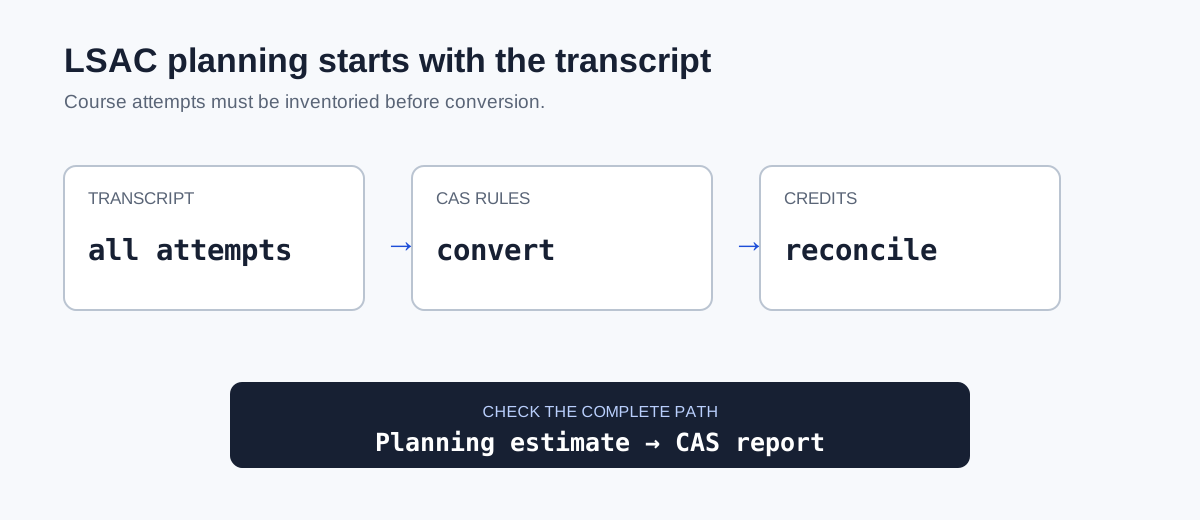
Use one row for every undergraduate course appearing on each required transcript. Preserve the transcript grade, attempted credits, repeat status, and any academic-forgiveness notation before applying a conversion. Keep excluded or unconverted work visible in a separate section rather than deleting it from the worksheet.
After calculating each institution and year, reconcile the combined attempted credits. A missing repeated course can make an estimate look better while moving it farther from the CAS summary.
Review every undergraduate transcript
Request personal copies early. Repeats, academic forgiveness, punitive failures, and grade symbols can be handled differently from the institution's GPA.
Reconcile every attempt before estimating the CAS GPA
Create a transcript inventory before applying any conversion table. Group courses by institution and academic term, but retain every undergraduate attempt that the reporting instructions require. Record the original grade symbol, attempted credits, repeat notation, and any academic-forgiveness notation exactly as the transcript displays them.
Then total attempted credits and quality points by institution and compare those subtotals with the combined worksheet. This catches a common planning error: keeping the replacement grade while silently deleting the first attempt. It also exposes courses whose credits were converted from quarter to semester units. The estimate is useful for planning, but the official CAS Academic Summary Report remains the result to rely on after processing.
Do not rewrite the transcript
Enter what each registrar issued. Let the current application-service instructions determine how that record is standardized.
A four-pass check for this method
A reliable law school lsac gpa estimate should leave an audit trail, not just a final number. Work through these four passes in order and keep the source for every scale, weight, credit value, and inclusion decision beside the calculation.
- Inventory every required undergraduate transcript and course attempt.
- Preserve original grades, credits, repeats, and forgiveness notations.
- Apply the current CAS conversion and inclusion instructions.
- Reconcile attempted credits before comparing the estimate with the CAS report.
After the four passes, change one input at a time and calculate again. The direction and size of the change should match the rule you documented. Preserve unrounded values until the final display, label hypothetical inputs, and keep institutional results separate from estimates created for planning. If the worksheet still disagrees with an official record, compare the included courses and denominator before assuming the arithmetic is wrong.
Compare institution and year subtotals with the complete inventory. A missing repeat or converted quarter credit can shift both the numerator and denominator of the planning estimate. Save the source date with the worksheet so a later policy change does not silently alter the meaning of the estimate.
Sources
You can use the cumulative GPA calculator for an informal school-GPA scenario, but it does not reproduce the LSAC Academic Summary Report or CAS conversion rules.